Physical Address
304 North Cardinal St.
Dorchester Center, MA 02124
Physical Address
304 North Cardinal St.
Dorchester Center, MA 02124

Implant placement is, at its core, a three-dimensional precision task. The surgeon must drill to a planned depth and angulation, respect sub-millimetre proximity to critical anatomical structures, and execute all of this through a narrow oral aperture, in a moving patient, under time and visibility constraints that no other surgical specialty quite replicates. Even with the best static surgical guide — the most widely used accuracy-enhancing tool in implant dentistry — deviation from the planned position is an acknowledged clinical reality. Published meta-analyses on static guide accuracy show angulation errors of three to six degrees. In implant dentistry, those degrees matter.
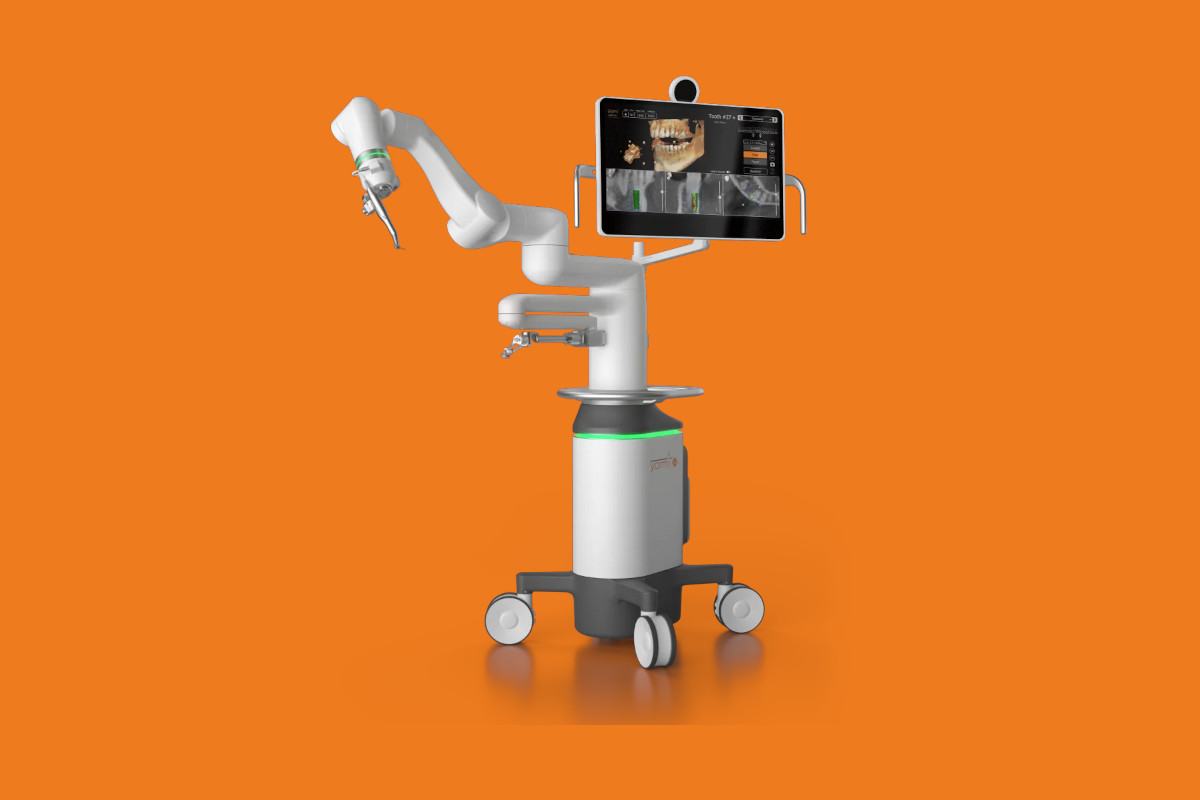
Robotic surgery in medicine has been transforming outcomes in orthopaedics, urology, and general surgery for two decades. Dentistry has been slower to follow — but that is changing rapidly. Yomi is the first and only FDA-cleared robotic system for dental implant surgery, and Yomi S was announced in 2025 as the second-generation system, combining real-time haptic guidance, pre-operative digital planning, and intra-operative adaptability to assist clinicians during implant cases. And in January 2026, Neocis announced that clinicians have completed more than 100,000 osteotomies using the Yomi platform — a significant milestone in the real-world adoption of robotic assistance in implant dentistry.
The most important thing to understand about Yomi — and the thing most often misunderstood by clinicians encountering it for the first time — is that it is not an autonomous robot. It does not drill by itself. It does not make decisions. Yomi is a passive implant robot: the surgeon is responsible for the robot’s entry and exit from the mouth, preparation of the implant site, and placement of the implant — the system provides visual guidance and physical feedback during the implant osteotomy process, but the surgeon maintains continuous control.
The mechanism that makes Yomi distinctive is haptic guidance — a system of physical resistance built into the robotic arm that constrains the clinician’s movements to the pre-planned surgical path. The system combines haptic guidance with real-time visual and auditory feedback, constraining instruments to the virtual surgical plan and enabling minimally invasive, flapless procedures whenever possible. Think of it less like a robot performing surgery and more like a highly intelligent guide rail — one that pushes back if the clinician’s hand drifts outside the safe zone, while allowing full freedom of movement within it.
Real-time patient tracking allows Yomi to provide accurate guidance even if the patient moves — a critically important feature in a conscious patient who is not under general anaesthesia and whose head position can shift during a procedure. Static surgical guides, by contrast, are fixed to the patient’s dentition at the start of the case and cannot compensate for movement that occurs during drilling.
The workflow begins with pre-operative digital planning using CBCT and intraoral scan data, from which the surgical plan is created and uploaded to the Yomi system. The surgeon specifies the location for implant placement, and during surgery the robotic system guides the drilling while automatically stopping at the appropriate depth. The surgeon executes — but within a precisely constrained envelope that enforces adherence to the plan.
The clinical evidence for Yomi’s accuracy is now substantial. The landmark study in this field was published in The International Journal of Oral and Maxillofacial Implants by Dr Jay Neugarten, DDS, MD, of the New York Center for Orthognathic and Maxillofacial Surgery — one of the most experienced Yomi users in the country.
The large prospective single-arm study evaluated 273 robot-guided endosteal implants placed over two years, finding that on average these implants deviated from their planned angulation and depth by less than 1.5 degrees and less than 0.2mm respectively — compared to published meta-analyses on other guided modalities showing angulation errors as high as 3 to 6 degrees.
The conclusion of the study is unambiguous: haptic robotic guidance enables higher accuracy and statistically greater precision than any other implant surgery method, including static guides, dynamic computer navigation, and freehand placement. For a specialty where the difference between a well-placed and a malpositioned implant can determine whether a patient needs revision surgery, those numbers carry real clinical weight.
Accuracy is not the only metric that matters in a busy implant practice. Procedure time, case throughput, and patient experience all factor into whether a technology delivers genuine practice value — and new 2025 data addresses these dimensions directly.
A prospective multi-site clinical study published in Dentistry Today in October 2025 compared Yomi to freehand implant placement in both partial and full-arch cases, finding that total procedure time savings for partial-implant patients averaged approximately 45% — and that Yomi saved an average of 80 minutes on full-arch cases from the patient’s start to finish procedural time.
An 80-minute saving on a full-arch case is not a marginal efficiency gain — it is a transformation of the procedural experience for both clinician and patient. For practices running high-volume implant lists, the cumulative impact on capacity and patient satisfaction is significant.
The minimally invasive dimension adds further patient-facing value. Robotic surgery allows for smaller incisions, resulting in less bleeding, less damage to the jawbone, and less disruption of soft tissue — with patients experiencing less swelling and pain and faster recovery with less likelihood of infection.
In 2025, Neocis announced and received FDA clearance for Yomi S — a redesigned second-generation platform that addresses several workflow and usability limitations of the original system. Yomi S is designed for a streamlined experience, sophisticated ergonomics, and superior accuracy, introducing AI for smarter planning, voice activation, and a redesigned experience for single-clinician control.
The single-clinician control feature is particularly significant for practice economics. One of the friction points in adopting the original Yomi system was the need for a dedicated team member to manage the robotic interface during surgery. Yomi S is designed to be operated by the surgeon alone — reducing the staffing overhead of robotic cases and making the workflow closer to that of conventional implant surgery.
The first clinical cases using Yomi S were successfully completed by Dr Jay Neugarten in early 2026, signalling the new platform’s transition from announced innovation to clinical reality. Neocis’ backing by NVIDIA’s NVentures and Intuitive Surgical’s Intuitive Ventures — the company behind the da Vinci surgical robot — gives the platform significant resources for continued development and suggests the strategic seriousness with which the medical robotics establishment views dental robotics.
Yomi is not the only robotic system now competing for the attention of implant surgeons. At IDS 2025 in Cologne — the world’s largest dental trade fair — Atomica AI, an Atlanta-based startup, made a significant impression with a different approach to the robotic guidance problem.
Atomica’s fully automated robotic system drew crowds at IDS 2025 for its surgical accuracy, intuitive control, and intelligent feedback system — with industry leaders, educators, and global distributors praising its precision and potential to redefine surgical workflows across implantology and maxillofacial surgery. Unlike the console-based Yomi system, Atomica’s robotic offering is designed around portability and a streamlined digital workflow that integrates scanning, planning, guide design, segmentation, and restoration into a single platform.
Atomica’s system offers sub-millimetre accuracy with robotic guidance that enhances clinician skills rather than replacing them — positioning itself with the tagline “the robot that follows you, not the other way around.” The company also launched three AI-powered software applications at IDS: an implant planner, a guide designer with stackable, sleeveless, and dual-arch compatibility, and a segmentation tool for rapid conversion of CT scans into surgical-grade 3D models.
The emergence of a credible competitor to Yomi is healthy for the field. Competition drives development, moderates pricing, and accelerates the pace at which robotic guidance reaches a broader range of practices and patients.
For clinicians evaluating whether to adopt robotic guidance, it is worth understanding where it sits in the accuracy hierarchy relative to existing alternatives. There are currently four primary approaches to guided implant placement: freehand, static surgical guide, dynamic computer navigation, and robotic guidance.
Freehand placement — the traditional approach — relies entirely on the clinician’s skill and spatial judgment. It is fast and requires no additional equipment, but produces the highest variability in outcomes. Static guides — the most widely adopted guided modality — constrain the drill to a pre-planned sleeve position and dramatically improve accuracy over freehand. Dynamic navigation uses real-time optical tracking to display the drill position on a screen, allowing the clinician to navigate without a physical guide but with continuous visual feedback. Robotic guidance, as the Neugarten study demonstrates, outperforms all three on accuracy and precision metrics.
The trade-off is cost and complexity. Robotic systems carry capital costs of $100,000–$200,000 USD, require dedicated training, and introduce a new layer of workflow complexity. For high-volume specialist practices placing dozens of implants per week, that investment case is straightforward. For a general practice placing five to ten implants per month, the calculus is more nuanced.
For patients, robotic implant surgery offers a straightforward proposition: greater precision in placement, less surgical trauma, shorter procedures, and faster recovery. Patients benefit from Yomi’s minimally invasive approach, experiencing less pain and quicker recovery times, while dental surgeons report increased confidence and control during procedures, leading to higher success rates and fewer complications.
The accuracy advantage also has long-term implications. Implants placed within sub-millimetre accuracy of their planned position are more likely to achieve the prosthetic emergence profile planned, to load correctly, and to distribute occlusal forces appropriately — all of which contribute to long-term implant longevity and peri-implant tissue health.
For patients researching implant treatment, it is worth knowing that robotic guidance is available, asking whether the practice they are considering offers it, and understanding that — like most advanced clinical technologies — the experience of the clinician using the system remains as important as the system itself.
The 100,000 osteotomy milestone places robotic dental implant surgery firmly in the category of validated, real-world clinical technology. It is no longer experimental. It is no longer confined to a handful of early adopters. The scale reflected in 100,000 osteotomies validates both the robustness of the platform and its proven ability to perform consistently across real-world clinical environments. DrBicuspid
What the next phase of development will determine is whether robotic guidance can extend its reach from specialist and high-volume practice settings into broader general practice — and whether the accuracy and efficiency advantages demonstrated in current studies translate into measurable long-term outcome improvements at the population level. Those studies are still being built. But the direction of travel is clear: robotic guidance is on a trajectory toward becoming the standard of care for complex implant cases, and possibly for routine cases beyond that.
Sources: Neocis press release, January 2026 (100,000 osteotomies milestone, Yomi S first clinical cases); Neocis press release, October 2025 (multi-site efficiency study, Dentistry Today); Neugarten JM. Accuracy and Precision of Haptic Robotic-Guided Implant Surgery in a Large Consecutive Series. Int J Oral Maxillofac Implants. 2024. Published in final form 2024, FDA 510(k) clearance Neocis; Atomica AI IDS 2025 coverage, March 2025 (Q1 global wins); PMC literature review, robot-assisted dental implant surgery (Yomi classification); Neocis product page, Yomi S, November 2025.