Physical Address
304 North Cardinal St.
Dorchester Center, MA 02124
Physical Address
304 North Cardinal St.
Dorchester Center, MA 02124

When most people think of dental implants, they picture a titanium post placed vertically into the jawbone directly beneath a missing tooth. That approach works well when there is sufficient bone at the implant site. In the upper jaw, however — particularly toward the back — bone loss after tooth extraction is common and often severe. The maxillary sinuses, which sit just above the upper back teeth, expand downward over time once teeth are lost, leaving little usable bone for a standard implant.
The traditional solution has been a sinus lift — a surgical procedure that grafts bone into the sinus floor to rebuild volume before implants are placed. It works, but it adds significant time and complexity to treatment, typically requiring four to nine months of healing before implants can be placed.
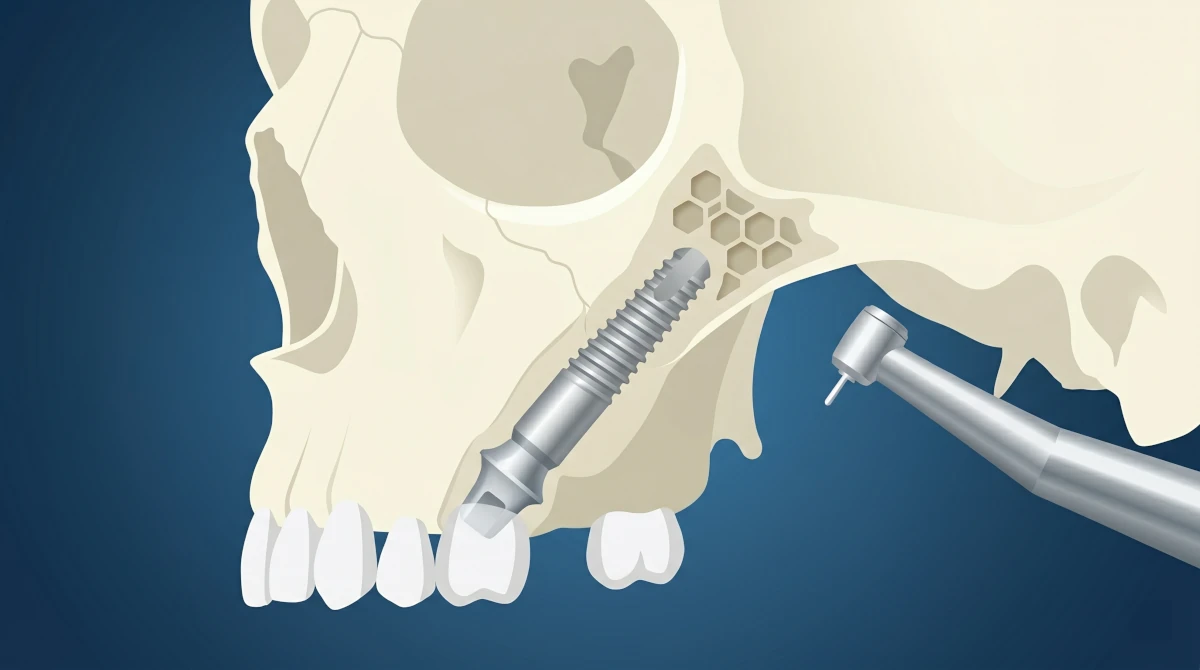
Pterygoid implants offer a different route. Rather than grafting bone to bring the implant site to the implant, the implant is directed to where dense bone already exists. The pterygoid process — a bony structure at the base of the skull just behind the upper jaw — provides a reliable anchor point that is largely unaffected by the bone loss that occurs in the posterior maxilla. A pterygoid implant is a longer-than-standard implant, placed at a specific angle so that its tip engages this dense bone, bypassing the sinus entirely.
The concept is not new — pterygoid implants have been documented in the literature since the 1980s — but their use has become more refined and more widespread as implant surgery has advanced.
Pterygoid implants are used specifically to replace missing upper back teeth — the upper molars and second premolars — in patients where bone volume in the posterior maxilla is insufficient for standard implants.
They are most commonly used as part of full-arch or near-full-arch upper jaw restorations. In these cases, pterygoid implants anchor the back of the bridge while anterior implants support the front, providing a stable, fixed restoration without the need for sinus grafting. This is particularly relevant for patients pursuing All-on-4 or similar full-arch solutions where the posterior support points are critical.
They may also be used for patients missing only the upper back teeth who want a fixed solution and either cannot undergo sinus grafting — due to medical contraindications or sinus pathology — or who wish to avoid the additional surgery and healing time it requires.
The surgical approach for pterygoid implants is substantially more complex than standard implant placement. The implant is inserted at an angle — typically between 45 and 60 degrees relative to the occlusal plane — and directed posteriorly and superiorly through the tuberosity of the maxilla into the pterygoid plates.
The region is anatomically dense with important structures, including the pterygoid venous plexus and branches of the maxillary artery. Precise planning using cone beam CT imaging is essential, and the procedure should only be undertaken by a surgeon with specific training and experience in pterygoid implant placement. This is not a technique that translates directly from standard implant surgery.
Due to the angle and depth of placement, the implant often engages three distinct bone layers — the tuberosity, the pterygoid process of the palatine bone, and the pterygoid plates of the sphenoid. This multi-cortical engagement is what gives pterygoid implants their notable primary stability, even in patients with compromised bone quality elsewhere in the arch.
Severe posterior maxillary bone loss Pterygoid implants are indicated precisely when standard implants are not viable in the upper back jaw. If your periodontist or oral surgeon has told you there is insufficient bone for posterior upper implants, or that you would need a sinus lift, pterygoid implants may be worth discussing as an alternative or complementary approach.
Intact pterygoid anatomy The viability of a pterygoid implant depends on the density and geometry of the pterygoid region itself. Most patients retain adequate bone here even after significant maxillary bone loss, but a cone beam CT scan is needed to confirm this before treatment is planned. Patients with certain anatomical variations or prior surgery in this region may not be suitable candidates.
Healthy sinuses While pterygoid implants bypass the sinus, the proximity of the implant trajectory to the sinus means that active sinus disease — chronic sinusitis, sinus cysts, or prior sinus surgery that has altered local anatomy — needs to be assessed carefully. These conditions don’t automatically rule out pterygoid implants but require thorough evaluation.
No active infection or uncontrolled systemic disease As with all implant surgery, active oral infection must be resolved before placement. Uncontrolled diabetes, coagulation disorders, and bisphosphonate use affecting bone metabolism are all factors that influence both candidacy and surgical risk. These need to be discussed transparently with your surgeon during the planning phase.
Access to an appropriately experienced surgeon This is a practical but important consideration. Pterygoid implant placement is a specialist procedure. Outcomes are strongly tied to the experience of the placing surgeon and the quality of pre-surgical planning. If you’re being offered pterygoid implants, it is reasonable to ask about your surgeon’s specific experience with this technique and to review their case volume.
The clinical literature on pterygoid implants, while less extensive than for standard endosteal implants, is broadly positive. Survival rates in published studies generally range from 90 to 96 percent over observation periods of five to ten years — comparable to conventional implants placed in good bone. The multi-cortical engagement that characterises pterygoid implant placement contributes to strong primary stability, which is a key predictor of long-term success.
Patient-reported outcomes, where captured, reflect high satisfaction with functional and aesthetic results — particularly among patients who avoided sinus grafting and the extended timeline it requires.
If you’ve been told you don’t have enough bone for upper back implants, or that a sinus lift is your only option, pterygoid implants are worth raising with a specialist. They won’t suit every patient or every anatomy, but for those who are appropriate candidates they represent a well-evidenced, graft-free route to a stable fixed restoration in the posterior upper jaw.
A thorough cone beam CT assessment and consultation with a surgeon experienced in pterygoid placement is the right starting point.
